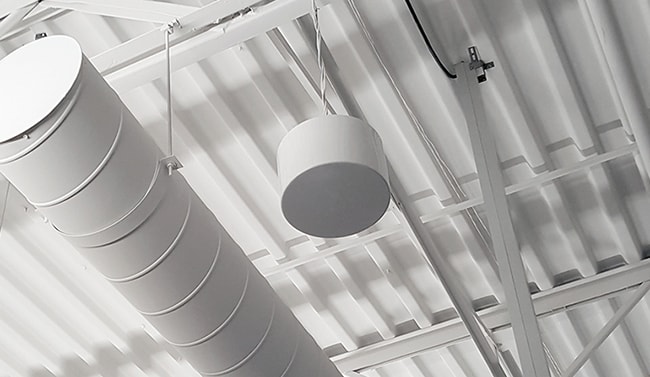
Sound Masking Systems
Create a more productive, private, and comfortable workplace with professionally designed sound masking.
Open offices, healthcare waiting rooms, and financial service environments all share a common challenge: unwanted noise and lack of speech privacy. T&M DataCom Services designs and installs sound masking systems that add a soft, unobtrusive background sound to the environment — raising the ambient noise floor just enough to make nearby conversations unintelligible and reduce distracting noise without making the space feel loud.
How Sound Masking Works
Sound masking doesn't eliminate noise — it makes speech less intelligible by adding a carefully shaped background sound (similar to airflow) that covers the frequency range of human conversation. The result is a space where nearby conversations fade into the background, reducing distraction and protecting confidential discussions.
Open-Plan Office Productivity
Open offices are notorious for noise and distraction. Studies show that unwanted speech is the #1 productivity killer in open workplaces. A properly tuned sound masking system reduces the radius of distraction — the distance at which a conversation becomes intelligible — from 50+ feet down to 15 feet or less, letting employees focus without the need for private offices.
Healthcare Speech Privacy
HIPAA requires that patient health information not be overheard by unauthorized individuals. Sound masking is one of the most effective and cost-efficient ways to achieve speech privacy in waiting rooms, exam areas, nursing stations, and administrative offices — without expensive construction.
Financial & Legal Confidentiality
Banks, law firms, and financial advisors handle sensitive client conversations daily. Sound masking ensures that discussions in open areas, conference rooms, and private offices cannot be overheard in adjacent spaces — protecting client confidentiality and your professional reputation.
Professional Design & Calibration
Sound masking is not plug-and-play. Proper system design requires acoustic analysis of the space, correct emitter placement and spacing, and careful post-installation tuning. Our technicians calibrate every zone to the ANSI/ASA S12.2 standard for speech privacy, ensuring the system performs as designed.